
Wood Lagging
We are often asked if you “slide the boards down” to install wood lagging. We wished that worked, but the ground exerts pressure on the boards, so they are stuck – at least they are supposed to be stuck.
Installation
On the first lift, wood lagging is installed by carefully trimming between the soldier piles and placing the lagging behind the front flange. Any gaps between the board and the ground must be backfilled with soil and compacted by hand tamping. The shoring performs best if it is tight to the existing ground.
When the second 5-ft lift is excavated, the ground pushes against the pile and wood lagging. This force prevents the lagging boards from being slid down. The second lift of lagging is installed by cutting the boards a bit shorter than the center to center pile spacing. This allows the workers to get the board behind one flange, have the board short enough to fit behind the opposing flange, then slide it over a bit so the board is behind both flanges.
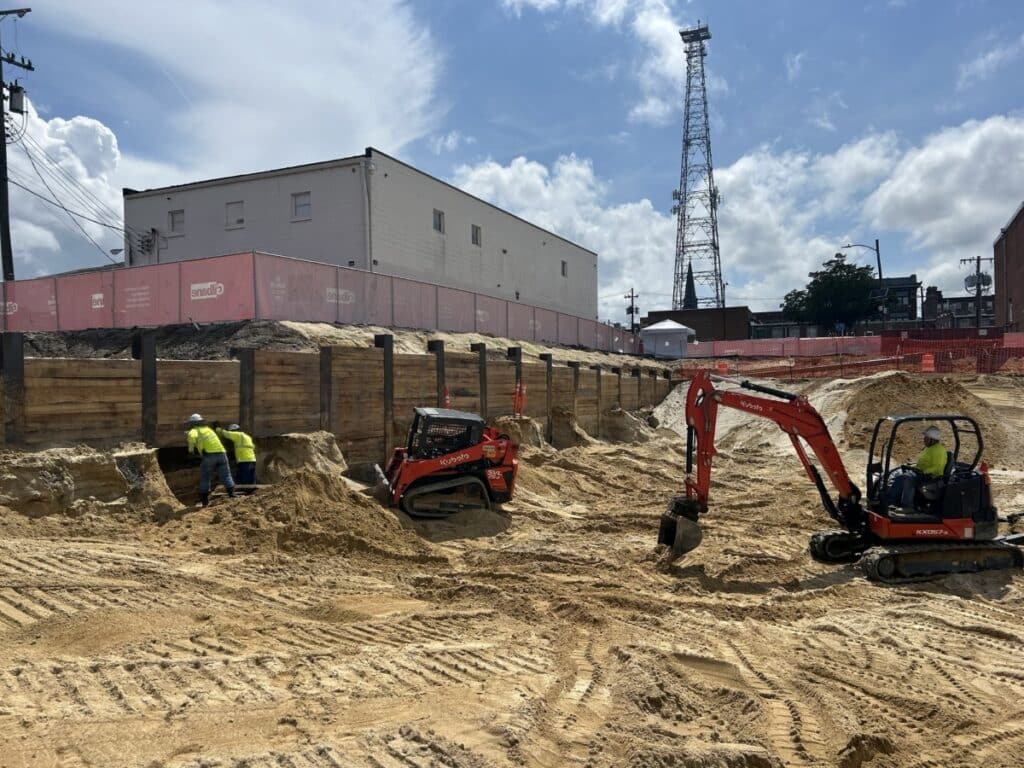
Installing Wood Lagging
Sometimes, particularly at university and hospital campuses, the owner wishes to have the upper 4 to 5 feet of shoring removed. In this case, the first lift of wood lagging is placed behind the back flange. This way, when the space between the shoring and basement is backfilled to within the last 4 to 5 feet, the entire steel pile is exposed. Assuming conditions allow for an unsupported 4 to 5 foot cut, the piles are torch cut and the piles and lagging are removed.
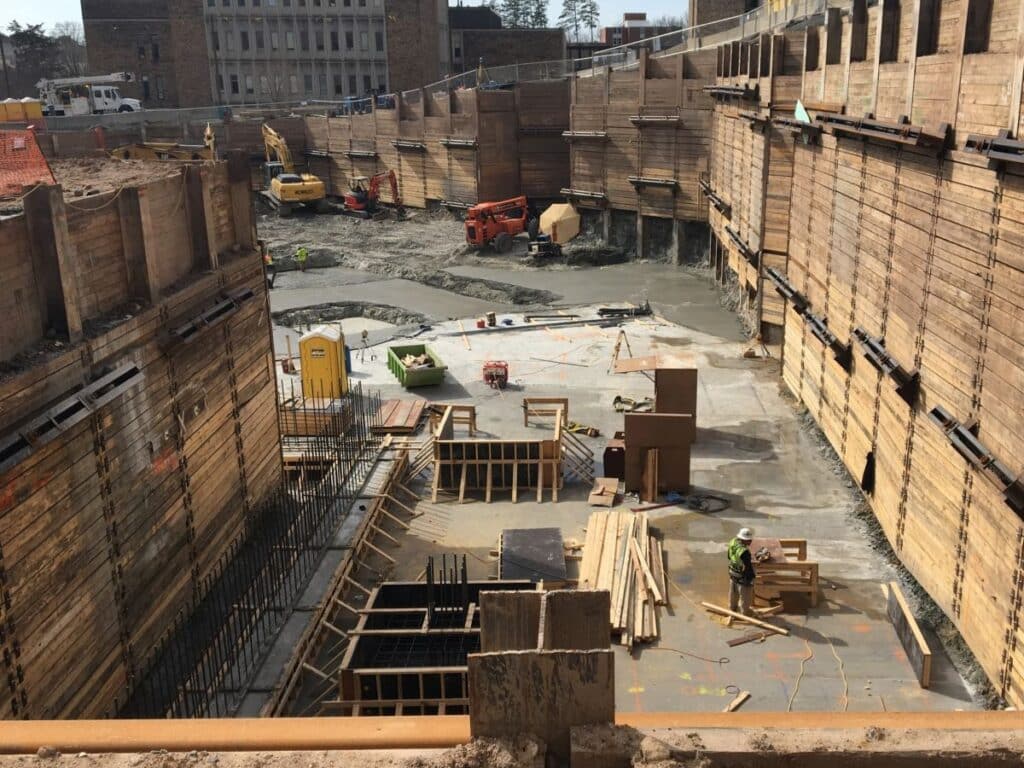
Lagging the Back Flange to Remove the Upper Few Feet of Shoring Later
Lagging Pipe Piles
When ground conditions like hard rock near the bottom of the excavation make installing pipe piles more economic than drilling large holes for soldier piles, the wood lagging is attached to the front of the pipe using threaded studs welded to the pipe with plate washers and a hex nut.

Lagging Pipe Piles
Lagging the front of the pile
Another reason to attach the lagging to the front of the pile is to secure hard ground without excavating it between the piles. The excavation subcontractor simply excavates to the front flange, and lagging is attached to the pile with threaded studs. Some shoring subcontractors use this approach 100% of the time, preferring studs to excavating between the piles.

Lagging the Front of the Pile
Final Thoughts
Mind the board width. Some vendors sell variable width wood lagging. This may make filling an order easier or more economical, but boards that are wide are heavy. It may be best to limit the width of the lagging board to lessen the chance of muscle strain. Installing wood lagging is hard work!